Chapter 6: The Instantaneous Rate of Change
1. Given 
2. Use the diff() and D() commands to determine the first and second derivatives of the following:
3. Use the Calculus Palette to determine the first and second derivatives of the following:
4. Determine the nth derivative:
5. There are two tangent lines to  that passes through the point
6. Use the DerivativeTutor() to create a plot of  and the first derivative.
7. Use the DiffTutor() to determine the first derivative of 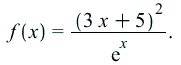
8. Given  and
and  :
:
- 9. Use the Tangent() function to determine the equation of a tangent line to
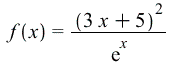 at
at  Verify the solution with a plot.
10. Find the cubic equation  given there is a maximim at
  and a min at
  .
.